Ford's 2025 truck lineup offers powerful towing abilities and next-gen technology. Need a light-duty pickup for weekend projects around Youngstown or a beefy workhorse for demanding jobs? Ford's got you covered. Join us as we explore what's available.
Importance of Understanding Towing Specifications
Knowing your truck's towing specs allows you to load up and hit the road safely. Ford emphasizes the importance of adhering to vehicle specifications to avoid accidents while towing. Exceeding the stated limits can reduce your control over the vehicle, increase your stopping distance, and lead to equipment failures — endangering you and others.
2025 Ford Truck Models and Their Towing Capacities
Ford's 2025 lineup ranges from the compact Maverick to the mighty F-350, with each model suited to different towing needs.
F-150
The 2025 F-150 pulls up to 13,500 pounds, letting you take your camper to Lake Milton or haul job materials with ease. Engine options include a 2.7L EcoBoost V-6 (8,400 pounds towing, 1,775 pounds payload), a 5.0L V-8 (12,900 pounds towing, 2,225 pounds payload), and a class-leading 3.5L EcoBoost V-6 (13,500 pounds towing, 2,440 pounds payload). None of these options will leave you short of power. The 3.5L EcoBoost delivers 400 horsepower and a hefty 500 lb-ft of torque, while the 5.0L V-8 offers 400 horsepower with 410 lb-ft of torque. If you only tow occasionally and stick to lighter loads, you might prefer the efficient 2.7L EcoBoost V-6, which puts out 325 horsepower and 400 lb-ft of torque. If you're looking to balance power with environmental awareness, the 3.5L PowerBoost hybrid delivers 430 horsepower and 570 lb-ft, towing up to 11,200 pounds with a 1,750-pound payload. It even includes a Pro Power Onboard outlet for powering tools at remote sites.
F-150 Lightning
The all-electric F-150 Lightning hauls 7,700 pounds (standard range, 2,235-pound payload) or 10,000 pounds (extended range, 1,800-pound payload). Instant torque makes pulling feel easy, and the Lightning's independent suspension makes rough roads a breeze.
F-250 and F-350
F-250s tow up to 23,000 pounds and F-350s manage up to 40,000 pounds. These aren't just bigger F-150s — they're purpose-built workhorses with stronger frames, beefier brakes, and heavy-load engines perfect for conquering Mahoning Valley inclines. Both these Super Duty models excel at heavy lifting, but the F-350 offers dual rear wheels, a sturdier frame, and tougher suspension for extreme loads, which is great if you're carrying tools while towing heavy equipment. The F-250 provides smoother daily driving while still handling weekend projects capably.
Ranger and Maverick
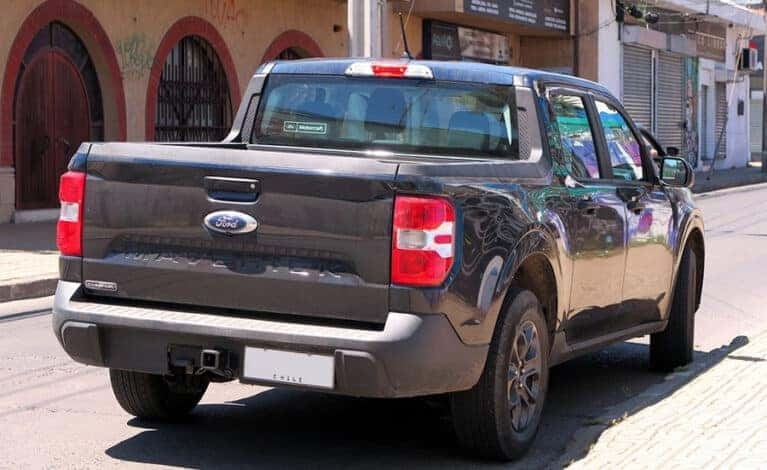
The midsize Ranger pulls an impressive 7,500 pounds, outmuscling some older full-size trucks, and provides strong low-end torque. The compact Maverick tows up to 4,000 pounds when equipped with the 4K Tow Package and drives like a car — perfect for commuters who sometimes haul ATVs or compact campers. Its hybrid option even lets you save on gas. Compact enough to negotiate downtown Youngstown parking spots yet easily able to handle campers, Jet Skis, and motorcycles, these smaller trucks are ideal if you tow occasionally but don't need F-150 size.
Key Towing Features and Technology in 2025 Ford Trucks
Along with offering power and performance, the trucks in Ford's 2025 lineup keep tabs on your trailer nonstop to address the everyday challenges of towing. Dash displays show hookup status, brake settings, and tire pressures — all viewable through the FordPass app before you hit the road. These aren't just bells and whistles — they're practical safety tools you can depend on.
Onboard Scales With Smart Hitch
Your truck functions as a scale. View the weight on-screen, see it in the app, or watch the taillights, which flash if you reach the limit. Smart Hitch monitors tongue weight, helping you achieve that crucial 10%-15% sweet spot.
Trailer Sway Control
Ford's system detects any wobbling early, applying the brakes and reducing power to restore stability. Remember to distribute your load properly for safety, especially if it's windy.
Pro Trailer Hitch Assist
Using cameras and sensors, this system steers your truck perfectly into position. You just control the pedals and make one trip to connect — no more frustrating alignment attempts.
Blind Spot Information System With Trailer Coverage
Blind spots can wreck your confidence when towing. Ford's Blind Spot Information System (BLIS) monitors your entire trailer length, alerting you when vehicles are out of sight alongside it — invaluable when you're merging onto Ohio's highways. The system works with trailers of all sizes, from small utility boxes to 30-footers, complementing safe driving habits for extra protection.
Other Helpful Features
Pro Trailer Backup Assist lets you steer with a simple knob. Turn Signal Camera View spots hazards, and Trailer Navigation helps you avoid tricky spots for towing.
How To Optimize Your Towing Experience
Know your Ford's limits, weigh loads carefully, and make the most of your truck's tech features. Check fluids and tires regularly, add cooling for summer, pick flat routes when possible, and allow for extra stopping distance on winter roads.
Understanding Weight Ratings
Weight ratings set safety limits. Gross vehicle weight rating (GVWR) caps truck weight, gross combined vehicle weight rating (GCWR) limits truck and trailer combined weight, and gross axle weight rating (GAWR) restricts axle loads.
Calculating Payload and Tongue Weight
Find the maximum payload by subtracting the truck weight from the GVWR. An F-150 weighing 5,000 pounds with a 7,050-pound GVWR gives you 2,050 pounds for people, gear, and tongue weight. Do this calculation first. Maintain tongue weight at 10%-15% of trailer weight for stability. This weight counts against your payload. Smart Hitch simplifies these calculations for you, helping prevent sway and suspension issues.
Best Practices for Safe Towing
Maintain a 60/40 weight distribution (60% forward of axles). Position heavy items low and centered, with all cargo firmly secured. Check connections, lights, tires, and chains first. Take a quick test-drive — odd noises or pulling spell trouble. On highways, double your distance, use Tow/Haul mode, turn wide, and accelerate gently.
Towing Checklist
Before hitching, inspect trailer tires, lights, hitch parts, and documents. While hitching, adjust height, cross the chains, connect the lights, attach the cable, and secure the coupler. Then test the brakes, check the tire pressures, secure your cargo, set your mirrors, and verify BLIS if it's equipped. On the road, stop occasionally to check the wheel hubs (warm is fine, hot isn't) and inspect your tie-downs, lights, and tires.
Experience Ford Towing Excellence
Ford's 2025 lineup merges towing muscle with safety tech. From the F-350's power to the Maverick's convenience, there's something for everyone. Ready to find your ideal tow rig? At #1 Cochran Ford Boardman, our experienced team will help you pick your perfect match and test out hitch systems with your trailer. Get in touch today and discover your next hauling partner.